 danny@fastfakediploma.com
 Whatsapp: +44 7395563575
 Fake Certificate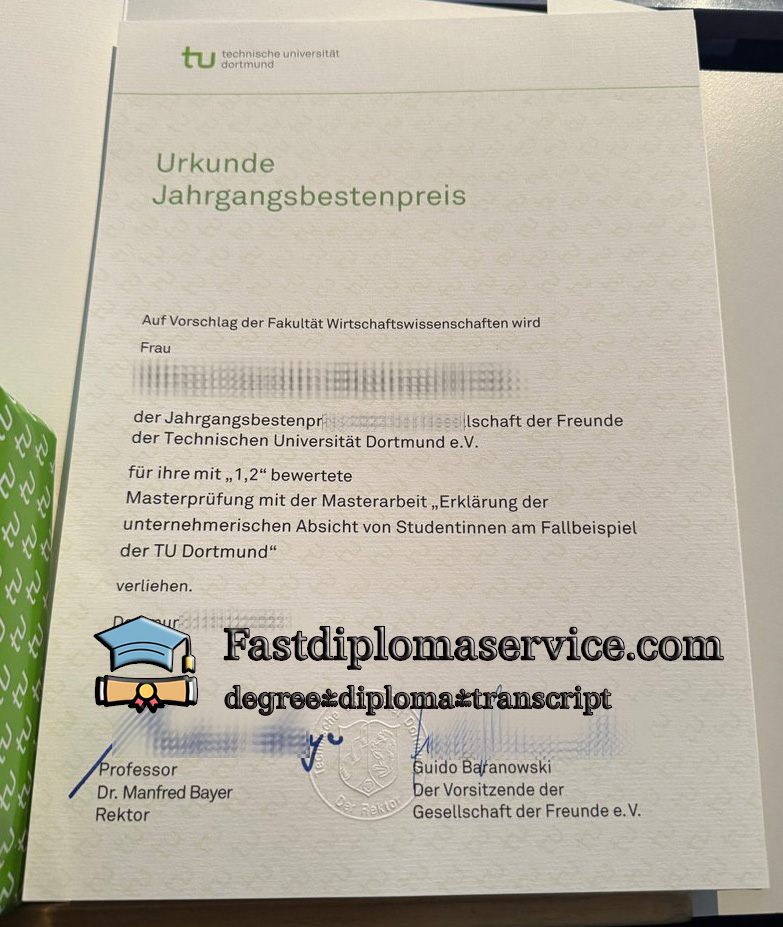
How can I order a TU Dortmund diploma?
Die Technische Universität Dortmund (kurz TU Dortmund; bis zum 1. November 2007 Universität Dortmund) ist eine technische Universität in Dortmund. An der TU Dortmund studieren 30.277 Menschen in rund 80 Bachelor- und Masterstudiengängen. Damit ist sie eine der 20 größten Universitäten in Deutschland. buy TU Dortmund fake degree online.
Der Förderatlas 2015 der Deutschen Forschungsgemeinschaft (DFG) listet die TU Dortmund in fünf Fachgebieten unter den „Top Ten“ der bundesweit forschungsstärksten Universitäten: in der Produktionstechnik, den Wirtschaftswissenschaften (inklusive Fachgebiet Statistik), der Werkstofftechnik, der Erziehungswissenschaft und in der Informatik.
How to get a TU Dortmund Degree
- Undergraduate (Bachelor’s) programs:
- Entry requirements: A recognized higher secondary school leaving certificate (e.g., Abitur) or an equivalent qualification. Some programs may require specific subjects.
- Language: German proficiency (often TestDaF or DSH) for programs conducted in German; some programs may have German-taught and English-taught versions.
- Application: Via the university’s portal or UniAssist for international applicants; deadlines vary by program.
- Graduate (Master’s) programs:
- Entry requirements: Bachelor’s degree in a related field, transcript, CV, motivation letter, and sometimes letters of recommendation.
- Language: English-taught master’s programs usually require TOEFL/IELTS for non-native English speakers; German-taught programs require German proficiency.
- Application: Direct through the program or university portal; check specific deadlines and required documents.
- PhD (Doctoral) studies:
- Entry requirements: Master’s or equivalent, research proposal, funding/position (often as a research assistant or funded project).
- Application: Contact potential supervisors or research centers; apply for available PhD positions.
Admissions and prerequisites
- Recognized qualifications: Ensure your diploma is recognized in Germany; if not, you may need a preliminary assessment (VPD) or a UniAssist evaluation.
- Visa and residence: Non-EU students typically need a student visa; plan for housing, health insurance, and living costs.
- Fees: Public universities in Germany usually have no tuition fees for standard degree programs, but there may be a nominal semester contribution (semester ticket, student services, administration).